Filament Non Woven Geotextile for Road Project in South Korea
Latest News · 2025-09-23 · 0 views
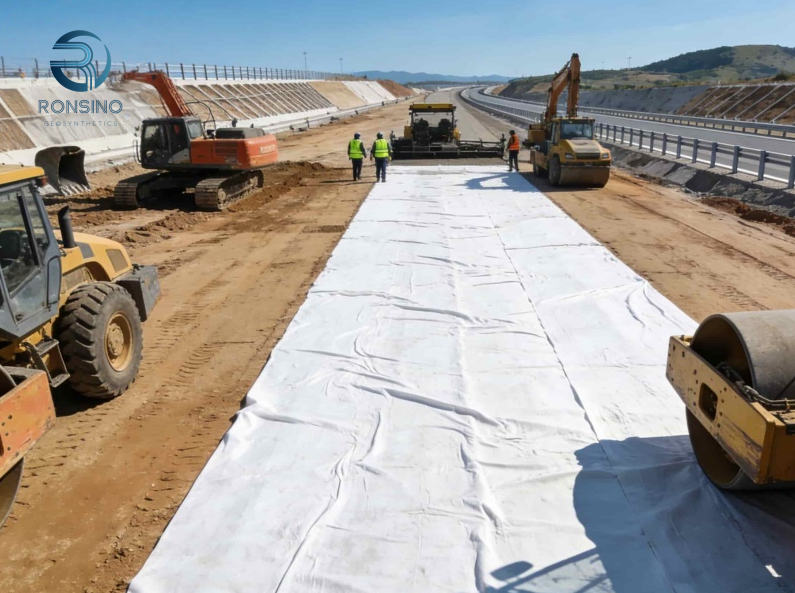
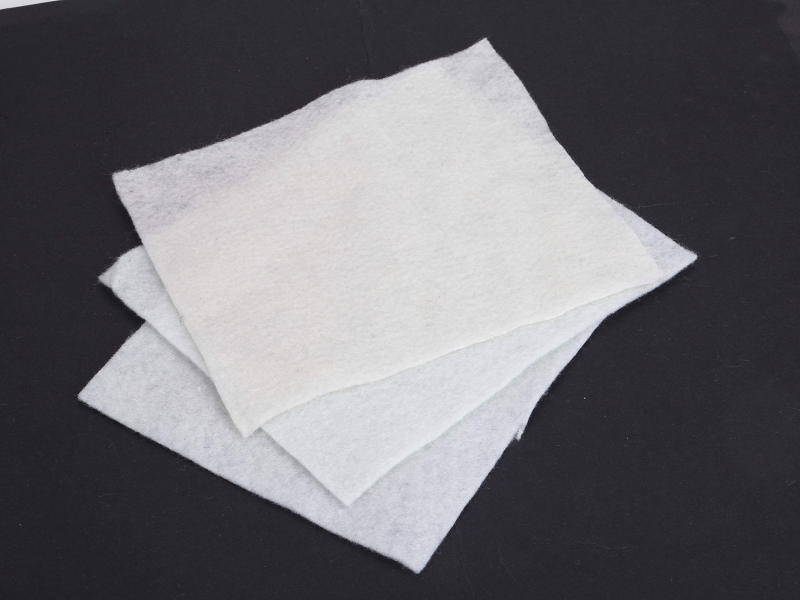
Filament Non Woven Geotextile South Korea is a top-tier geosynthetic material fabricated via the spinning procedure and needle-punch consolidation of high-quality polyester filaments.Its available product specifications cover a gram weight range from 100g/m² to 800g/m².This polyester geotextile membrane boasts exceptional mechanical performance, reliable corrosion resistance, excellent UV aging resistance, as well as a diversified aperture range with staggered zigzag pore distribution.
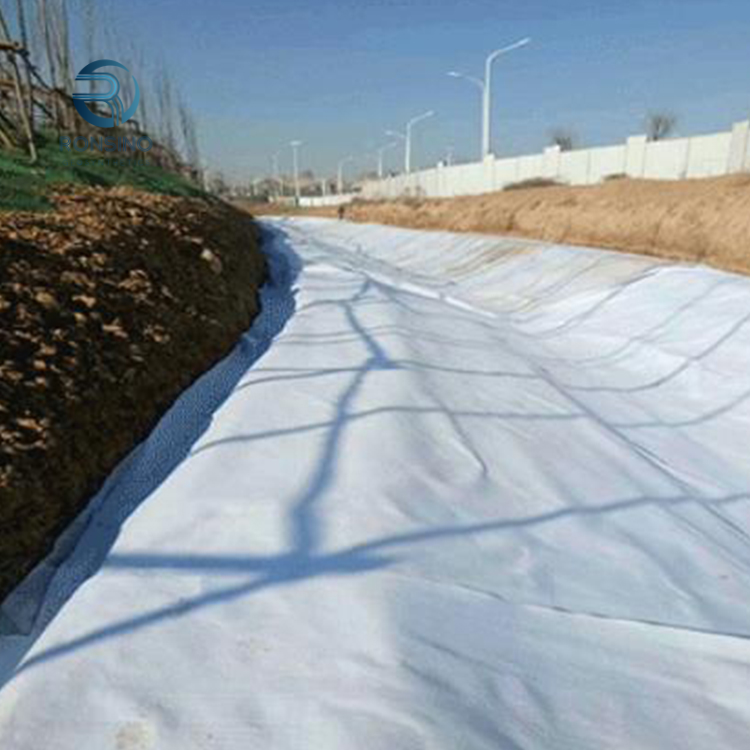
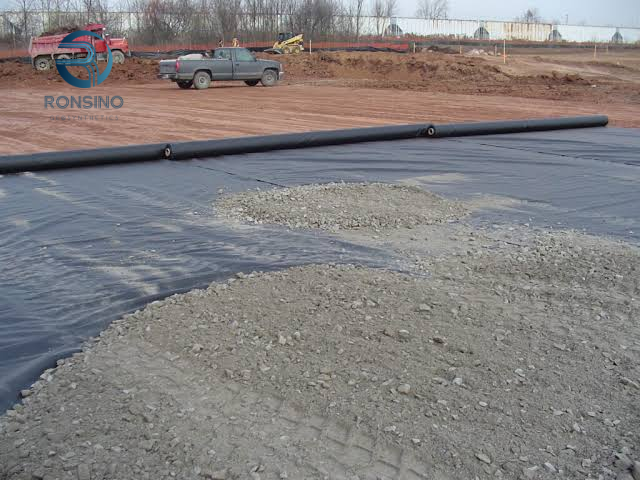
This high-performance synthetic geotextile applies to engineering scenarios including road foundation reinforcement, embankment support, slope stabilization, seepage prevention, retaining wall reinforcement and pavement durability improvement.
Spunbond nonwoven geotextiles fit South Korea's diverse soils (clay, sand, gravel) well: they boost soil cohesion and structural integrity, reduce erosion and subsidence risks, block foundation water infiltration, support water conservation and extend transport infrastructure service life.
Filament geotextiles for South Korea's road construction mainly enhance roadbed stability, prevent soil displacement and settlement, improve pavement load distribution capacity and service life to adapt to local complex soil and climatic conditions.
For a state-funded expressway project, a South Korean construction firm contacted RONSINO's sales team via its official website, requesting full technical specifications, samples and third-party lab certifications for filament geotextiles, with focus on chemical corrosion resistance.
RONSINO recommended the 300g/m² polypropylene filament geotextile tailored for the South Korean market per project requirements. After the client tested samples at an accredited lab and confirmed the product outperforms specified standards, both sides negotiated order volume, payment terms, logistics and other details, then signed a formal cooperation agreement.
1.What Are The Main Characteristics of Filament Non Woven Geotextile South Korea?
1.Durable permanent isolation: Forms reliable barriers between soil layers of different compositions and physical-mechanical properties, prevents stratum intermixing, and meets engineering frost resistance and load-bearing construction specifications.
2.Excellent filtration and corrosion resistance: Allows unobstructed all-directional water penetration without extra hydrostatic pressure buildup, intercepts fine soil particles to avoid soil loss, improves geotechnical structural stability and enhances the system's long-term anti-corrosion performance.
3.Stable reliable drainage: Its unique 3D fluffy porous structure efficiently regulates surface drainage for geotechnical works.
4.Superior protection: Outstanding puncture resistance, excellent extensibility and fluffy cushioning structure effectively protect waterproof layers from all potential mechanical damage during construction and operation.
5.Effective reinforcement: Its internal fluffy interlocking structure and high tensile strength improve the project's overall structural stability and strength.
6.Qualified UV resistance: Meets customers' customized demands, passes the international 500-hour UV aging test with a post-test strength retention rate of 50%-70%. Higher unit area gram weight corresponds to higher strength retention rate after UV aging.
2.Why Choose Filament Geotextile South Korea?
Excellent Durability: Filament geotextiles have high long-term stability, withstand prolonged immersion and oxidative corrosion, and maintain stable performance under harsh conditions for years, making them a preferred material for tailings treatment.
Superior Anti-seepage Performance: Their high impermeability effectively resists osmotic pressure and tailings erosion, greatly reducing leakage risks of tailings disposal systems.
High Tensile Strength: Outstanding tensile strength allows them to bear heavy static and dynamic loads, perfectly suiting tailings dam reinforcement, stabilization and protection needs.
Convenient Construction: Adaptable to construction requirements of different tailings dam projects, they are easy to operate on site and fast to install, effectively shortening the construction period and improving work efficiency.
With the above superior properties, filament geotextiles are highly applicable to tailings treatment scenarios, and can provide reliable, efficient targeted solutions for South African tailings disposal clients.
South Korean filament non-woven geotextiles also have excellent heat and light aging resistance, with no obvious performance degradation even after short-term exposure to nearly 20°C. Both lab tests and practical application cases prove that polyester geotextiles have long-term corrosion resistance against erosion from surrounding soil, water and microorganisms.
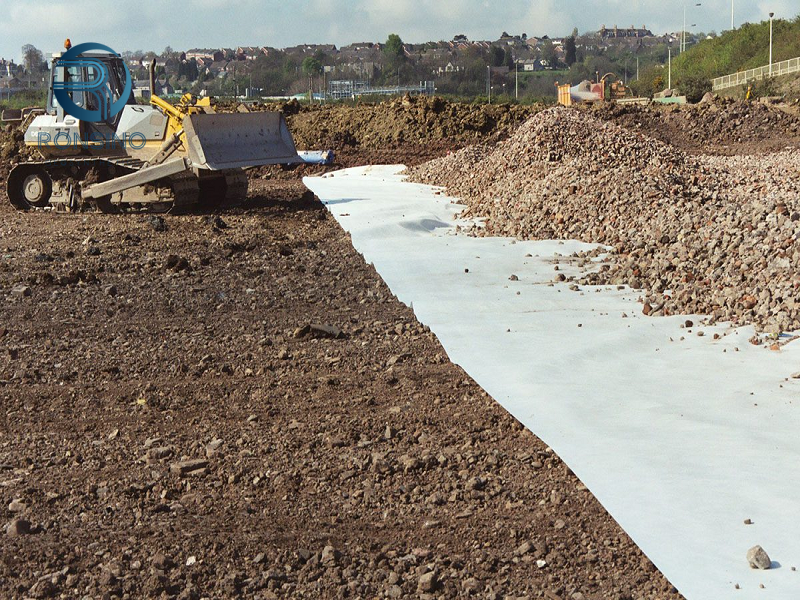
3 How To Lay Filament Non Woven Geotextile
3.1 Storage, Transportation, and Treatment of Geotextiles
Take effective precautions to avoid damage to geotextile rolls before they are installed.
Geotextile rolls shall be stacked on a flat site free of accumulated water, and the maximum height of the stacked pile shall not exceed 4 rolls. Make sure the identification tag fixed on each geotextile roll stays clearly visible.
All geotextile rolls shall be fully covered with opaque shading materials, so as to prevent performance deterioration caused by ultraviolet aging.
The completeness of product labels and relevant parameter data shall be strictly maintained during the whole storage period.
South Korean geotextiles shall be properly protected from damage throughout the transportation process, including the on-site transfer from the storage location to the construction work area.
Geotextile rolls with minor physical damage shall be repaired properly, and geotextiles with severe abrasion damage shall never be put into use.
Geotextiles that have been in contact with leaked chemical agents are strictly prohibited from being used for construction.
3.2 Filament Non Woven Geotextile Laying Method
3.2.1 Manual Rolling
Ensure a smooth cloth surface and leave a margin for deformation.
3.2.2 Filament Installation
Adopt construction techniques such as adhesive bonding, mechanical stitching, or thermal welding to complete the connection work.
The width of stitching and welding joints shall generally be greater than 0.1m, and the overlapping width of adjacent geotextile components shall generally exceed 0.2m as per construction specifications.
Welded or stitched geotextile sections may be exposed to the open external environment for a long time during the construction or operation stage.
3.2.3 Stitching of Geotextile
1.Only continuous uninterrupted suturing is allowed; spot stitching is strictly prohibited.
2.Pre-stitching geotextile overlap width shall be ≥150mm, with a minimum 25mm distance between the suture line and the fabric's exposed edge.
3.Seams shall use locking single-thread chain stitch, stitched with resin thread of minimum 60N tensile strength, whose chemical corrosion and UV resistance are no lower than that of the geotextile itself.
4.All missing stitches in the construction area must be fully re-stitched.
5.Protective measures shall be taken after laying to prevent soil, fine particles or other impurities from entering the geotextile inner layer.
6.Geotextile overlapping can adopt natural lapping, sewing or welding based on actual terrain and application scenarios.
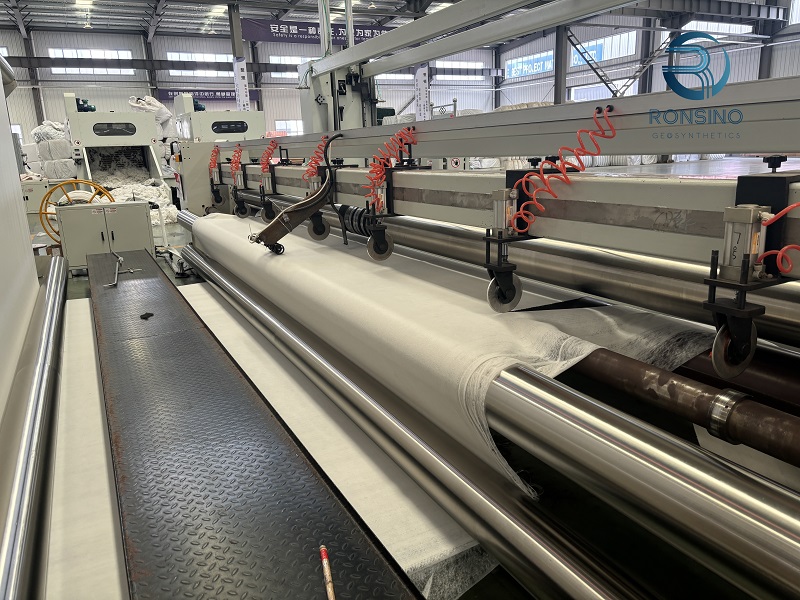
4 Specifications of Filament Non Woven Geotextile for Road Project in South Korea
PP Filament Geotextile 300gsm
Total Quantity –200,000 Square meters
Each roll Size – 4m*100m
Standard – ASTM standard
RONSINO specializes in manufacturing geosynthetics products to worldwide customers since its foundation in 2007. If you have any questions or inquiries, please fill and submit the following form, we will reply as soon as possible.